

Veranda Rights
Towards an Architecture of Repair
By Thomas de Monchaux
“That’s where your passport goes,” Dana Vachon says, when we meet in the lobby of Lisbon’s Amoreiras Hotel. He’s pointing to the signature zip pocket on a classic valise by the French leather maker Berluti, a gift from Jim Carrey to celebrate the sale of their novel Memoirs and Misinformation. Inside the bag: that book, a surprisingly heavy little library of other volumes, and two packs of American Spirits. The lobby’s Christmas tree is still glittering. I hand Vachon the valise, and feel for the moment—a live drop—as if I were a tinker, a tailor, a soldier, and a spy. Just landed from a dark New York, I hadn’t used my own passport for anything but work trips and family duties in a long time.
Starting with that strange day in March of 2020, when all flights out of JFK were grounded by COVID, I spent five hundred days in a row on the island of Manhattan, and I lost heart. In quick succession, the deaths of my parents and a breakup had left me not with the wisdom of the far shore or the calm after the storm, but mostly just a feeling of being out of practice at the things that really matter—a feeling that arises even now. But I’d made it to Lisbon for a beloved friend’s fortieth birthday. It had been strangely hard to arrange this simple and good thing. It had somehow helped that the flight over had also been dignified with this assignment—the side quest of couriering over the bag after various repairs, reconditionings, and restorations by Berluti in Manhattan. Leather teaches you about repair. It’s forgiving to the user and the restorer. As life beats it up it just gets better, cooler, softer, stronger.
In the sunny courtyard beyond the lobby we light two American Spirits. As a 21-year-old I assigned myself a lifelong streak of never purchasing a pack of cigarettes, but I have never once regretted smoking one when offered. I feel the nicotine ascend my spine. Vachon and I talk about restoring, refurbishing, about all kinds of stewardship.
“The new wing of the Gulbenkian Museum is a disaster,” he reports, “it contains all the hubris and con art of the post-COVID world. The old wing is a masterpiece. It contains all the humbleness and grace of the immediate postwar. How lovely it would be if an architect fell out of the sky, and wrote about this.” Vachon—providing another useful assignment—suggested I write it up for you, here, dear readers of Thunderdome.
So I make the first of three visits to the museum.
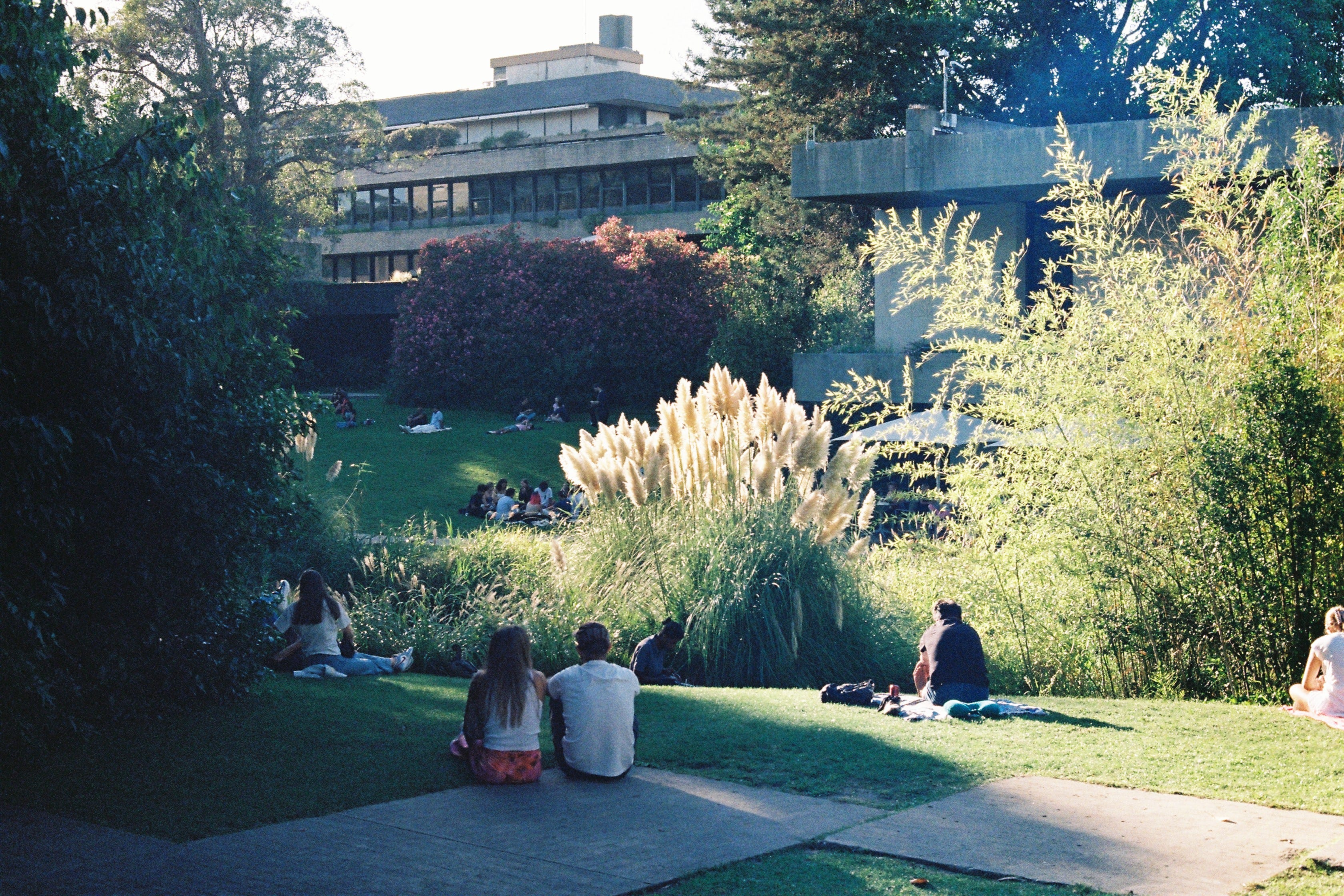
The Gulbenkian Museum was a private project in the public interest, developed between the 1960s and 1980s by the Armenian oil magnate Calouste Gulbenkian. It’s a leafy campus of galleries, concert halls, libraries, cafés, bars, and gardens. Its modern wing—the Centro de Arte Moderna, or CAM—was designed in 1982 by English architect Leslie Martin (1908-2000), in collaboration with Portuguese architect José Sommer Ribeiro. Martin was a poet’s poet of an architect who started out working on railways and demolitions for the British during the Second World War, and who would over generations guide the development of the whole Gulbenkian complex. His design for the original CAM was modern. It was durable and protective, in visible recollection of the bunkers of war. But it was a friendly bunker—opening up from ground to sky, gently ascending in terraced slabs of concrete and glass. Over time, like an old Mayan pyramid, it became overgrown—deliberately—with plants.
The result seemed both ancient and futuristic. And, because it stepped down so carefully to the human scale, it was grand without being grandiose. Inside those terraces was an exhibition hall above and a small permanent collection below. Because the landscape architecture and architecture were so seamlessly blended, you could come and go as you pleased, and the mild attacks and retreats undertaken by museum-goers were a delight. The recent addition and renovation, as we’ll see, so messes this up as to require the question: why are we now so bad at the things we were once so good at?
How have we in the high-GDP world become so much worse at such essential collective tasks and duties as the making of the built environment in the service of human delight and planetary stewardship? That’s the kind of question usually asked by some trad tory classicist who says “timeless virtues” when he means old-fashioned vices. It’s a strange new question for a modern architect such as I to ask.
Modernism in design is a movement for all time—the opposite of a style or a fashion or a trend. Its generations of innovators, from Charlotte Perriand in Paris in the 1920s to I.M. Pei in New York in the 1960s, all shared an idealism about design as the essential way to elevate human experience (“a machine for living”); and a discipline about using materials resourcefully (“less is more”) and honestly (“form follows function”). No more superficial imitation or colonial appropriations of the aesthetics of distant times or places. Modernism in design was a response to modernity in history: to a nineteenth century of political, economical, and industrial revolutions. Which was why early Modern design, all steel and glass and concrete, drew inspiration from: race cars, airplanes, ships, factories. And from bunkers and hospitals too: it was a way of processing trauma at a civilizational scale—two high-tech World Wars, plus the forgotten but epochal influenza and tuberculosis epidemics in the 1910s and 1920s. This made Modernism’s early spirit both ecstatic and sober. Pleasure and wellness were taken seriously, but so was restraint, rigor, social and environmental responsibility. So it’s a crisis, commensurate to other collapses of the global postwar order, that we today are no longer good at being modern.
An example of this de-skilling is the “new wing of the Gulbenkian,” that Vachon told me about: the 2024 renovation of Martin’s modest masterpiece by Kengo Kuma, a contemporary Japanese architect who rose to fame with his Japan National Stadium for Tokyo’s Pandemic Olympic Games of 2021.
That arena vibed “ecological” thanks to a lot of fussy little woodsy bits, plus very many shrubs in tubs. Because the stadium was really held up by high-carbon and high-energy steel and concrete, this is greenwashing—the dressing up of unsustainable work in eco-friendly disguise. In a formula that Kuma has repeated prolifically, the woodsiness enabled the work to, with minimal actual craft, evoke in modernesque work the profound inheritance of timber in traditional Japanese architecture. At the Gulbenkian, the local harvest of this aura farming is—the museum capitalizes it on their map—the Engawa. This is a Japanese term for what other cultures might call a veranda or a lanai. Historically, the word has described a complex mediation between indoors and outdoors: a raised interior floor stepping down to the ground, past intricately choreographed doors and windows dynamically calibrated by sliding paper and wood screens. This threshold, so deep and variable, becomes its own in-between place—offering both refuge and prospect, inside and outside, and the best of both. “An engawa can create connection,” Kuma told the design press, “and connection is really important for the future [of the] museum.”
Connection is really important. No connection is created at the Gulbenkian “engawa” because there is no engawa. The purported engawa is not one because 1. it is detached from the building by a significant meter, effectively rendering it a freestanding folly whose huge, inverted-McDonald’s-M-catenary-curved roof is discontinuous with the roof of its adjacent building; 2. along the side where it encounters that building, it slams into a blank wall; and 3. it faces the wrong way. The old building stepped up, north to south, to address the glorious Gulbenkian gardens; the non-engawa turns its back on those gardens and looks south onto a sad bit of grass, swooping from a very high 6 meters by the building to very low 2 meters (by the sad bit of grass) such that the untrained eye perceives it, in perspective, as another blank wall.
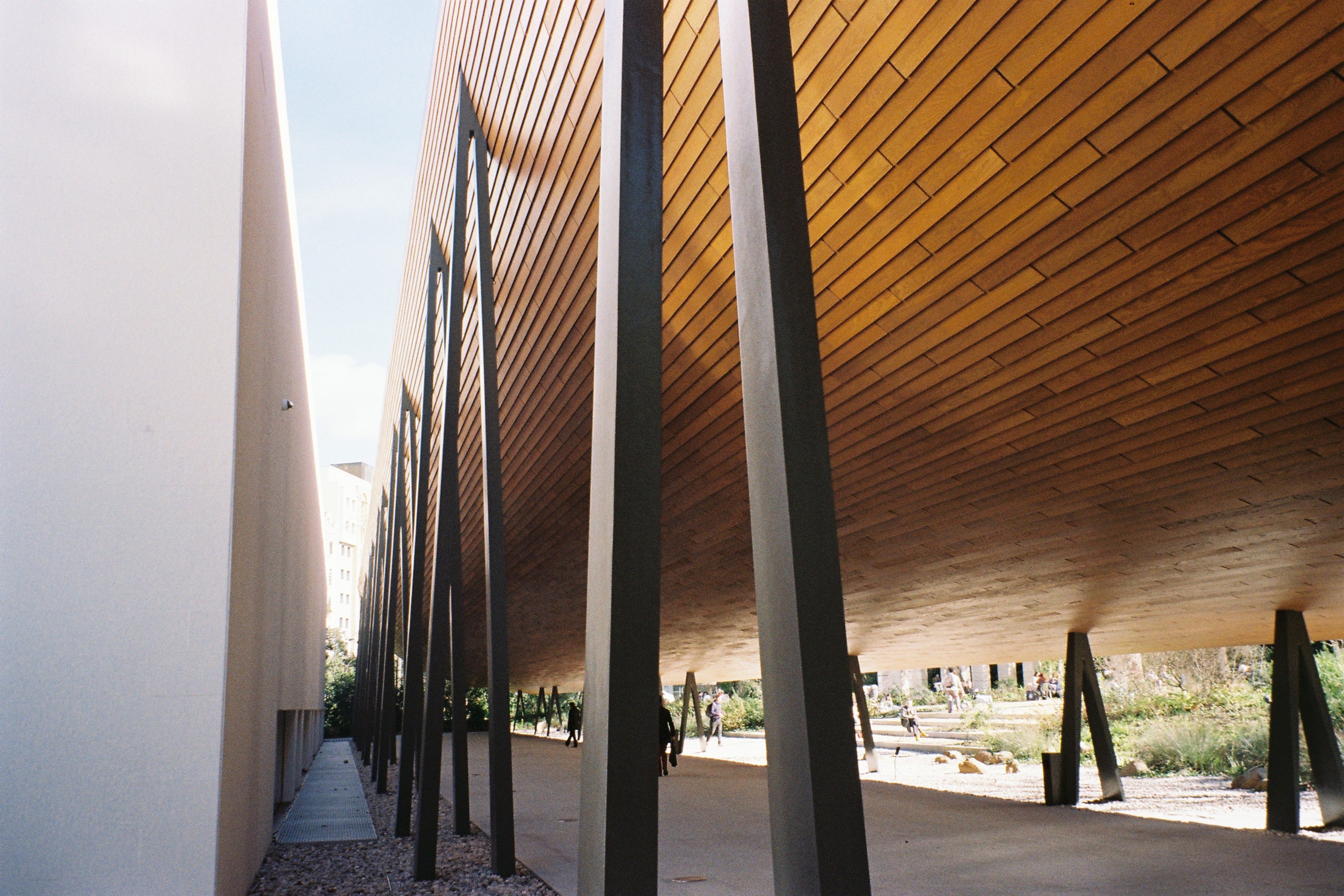
And the untrained eye is right. From without you see only its pale clay tile roof. From within, its dark wooden ceiling. Somewhere in the publicity materials we’re told that because the clay tiles evoke Portuguese pottery, and the wooden boards Japanese carpentry, that East and West, earth and sky are united into one glorious and possibly neoliberal something.
But what thing? With its patina and greenery erased, the whole feels like that sterile space so beloved by our ever more discredited would-be governing class: a private airport. Or, more prosaically and only fractionally more democratically, like that commonplace asset prioritized by many new museums: a rentable space for aspirational corporate events.
Deep in an airless basement, reached by a steep steel staircase and overlit by icy LEDs, is the Gulbenkian’s collection of contemporary Portuguese art. To help you find it, the ticket-seller, like the deputy concierge at a tourist hotel indicating the way to the old town, will draw arrows all over your pamphlet map with her ballpoint pen. Modern art museums should not require this: they should be secular sacred spaces dedicated to the arts of wandering, navigating, noticing. They should reward the urbane inner compass whose cultivation is the best consequence of living in cities and on computational networks. They should answer to the joy of our innate human capacities for seeking and hiding, gathering and hunting, losing and finding our way.
The gift shop, which the steep stair points you at as you ascend to ground level, is tall and narrow, like a chapel. It has a nice skylight. It is the one good room in the renovated museum. Here you can buy picture postcards of the renovation that make it look lively and humane.
What was Kuma thinking? His is a busy office. Possibly, like many architects at his level of global success, he titrated just enough of something specific—really just the branding provided by that engaging word engawa—into something generically legible enough to get the gig. But then he didn’t do the gig. Which is to do a good museum. Another possibility is that he genuinely thinks he did a good museum and integrated local and global, art and design, East and West, clay and timber, earth and sky. There are modern architects who harmonize in this way. Francis Keré reinterprets the heaviness and lightness of traditional Burkinabe building. Tatiana Bilbao and Frida Escobedo and Rozana Montiel reveal how Mexico City can be a model for complex and colorful cities of the future. Marina Tabbasum applies to global streetscapes the ebb and flow of the riverine landscapes of Bangladesh. I wish one of them had done the Lisbon job.
It’s bad enough to be told that something is what it plainly isn’t. That a war is not a war. That a pretender is a king. Even just that a non-engawa is an engawa. But the stakes are even higher in Architecture. Because design still—just—goes harder than any algorithm. “We shape our buildings, and afterwards our buildings shape us,” said the great anti-fascist Winston Churchill. The line is from his speech on the reconstruction of the House of Commons, partially demolished in the Blitz. Many wanted a new House somewhere far from London, maybe constructed in a circle on the increasingly fashionable Continental model. Churchill prevailed. He wanted the place to be reconstructed just where it was and as it was. Deliberately too small, to require mutual accommodation even in rhetorical combat; and bilateral, with symmetrical bleachers positioning parties face to face, so all could see even in their opponents a reflection of themselves.
A reason to love Churchill’s remark is when it was made: October of 1943—while the bombs were still falling. The idea was, I think, that we begin before we are finished. We start the rebuilding before the unbuilding stops. If ever it does. Because when you’re still inside World War Two you don’t know that the good guys are gonna win. Or that Swinging London or il boom or Les Trente Glorieuses (including the gratifying ascent of Berluti to a maker of the perfect passport-pocket valise) are coming. You don’t know how or when or even whether it ends. But you must plan for the peace. You continuously repair the vessel even as it keeps getting broken.
The diminution of the CAM building by its recent renovation is, relative to such history, a minor injury. And yet to injure anything is to injure—in part, and however small—everything. Happily, that also goes for healing. The good news about architecture is that—unlike art on a museum wall—it’s never finished. It’s never too late. Buildings, even more than leather bags, get even better with wear and repair. An engawa is a good idea. And the non-engawa could still—by adding windows and doors in that near-blank wall; by adding ramps and steps and platforms and thresholds on which to wander and linger—become the real thing. Once we recognize the damage, repair is almost always possible.
This is our general assignment for today. True architecture of repair is not false or pretty or cloying, or even easy to experience. It does not suppress the truth, whether that truth is hard or good. It inspires you to play but it is never itself playful in your stead. It beckons but never beguiles. This goes for literal architecture—the most direct way of making the world we have into the world that should be. And for every other figurative kind of architecture: security, treaty, information, network, cognitive, and more.
If only there were such an architecture, so that we could see it and learn from it and make more of it! Fortunately, there is: all of the old, and still standing, Gulbenkian. In its eight-hectare campus of landscaped gardens, there are long low museums and concert halls and libraries in concrete and glass—what you might recognize as Brutalist architecture. Brooding on the outside, effervescent on the inside, they were designed, in concrete, stone, bronze, bronzed glass, and local hardwoods, by Portuguese architects Ruy d’Athouguia, Alberto Pessoa and Pedro Cid, in consultation with Leslie Martin, between 1960 and 1969. Although the landscape is as pretty as a postcard, it’s designed not only for looking at but for venturing into. There is always more than one way to get anywhere, among the wild figs and ferns: a direct path in broad steppingstones, and a detour into the green. You can lose yourself, but you won’t get irretrievably lost. The same goes for the interior galleries and lobbies whose cinematographic sight-lines and deliberate ascents and descents all gently test and richly reward your capacity for reorientation and self-righting. It’s all an adventure playground for grown-ups—to help them keep growing up.
The 1969 Gulbenkian is how it is because for eight months, from September of 1940 to May of 1941, the Luftwaffe dropped approximately 26 million pounds of explosives and incendiaries on London; and in 1948, Leslie Martin, at 37, designed The Royal Festival Hall—which opened in 1951 as the anchor of what is now the Southbank Centre of theaters and concert halls and galleries in London—where he first tried out the architecture of repair that he would bring to Lisbon. On the Thames, the need was for the physical repair of actual craters from actual bombs; and for a spiritual repair of a grieving people. Because to work with the body is to work on the soul.
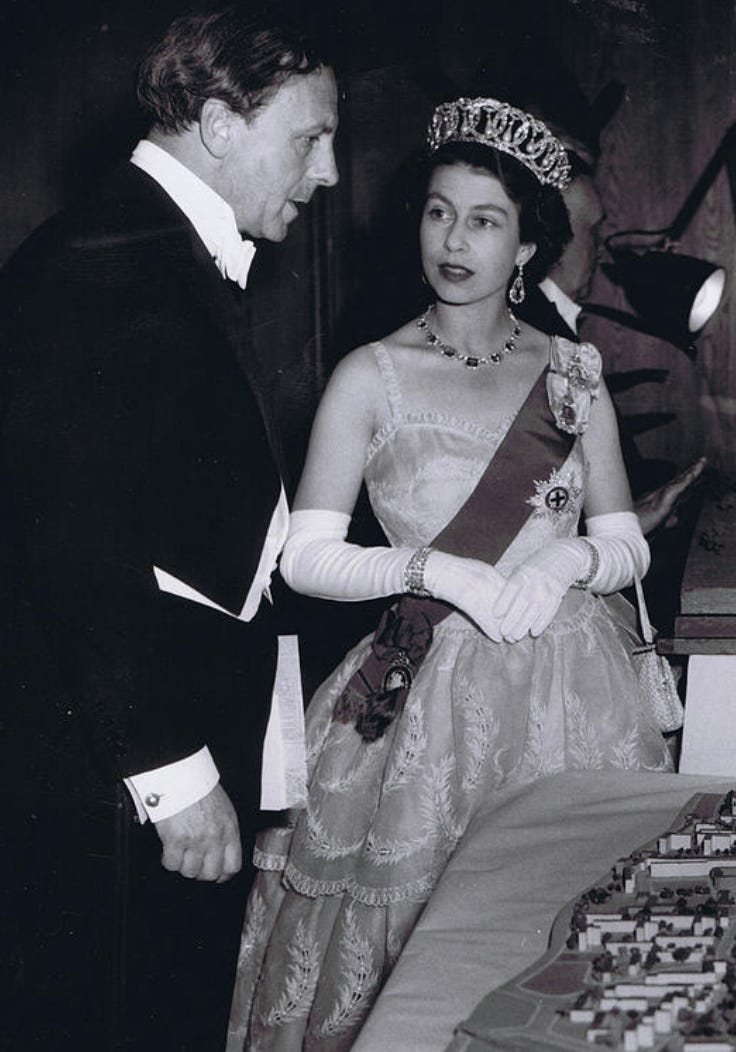
You can see in The Royal Festival Hall so much that would be later perfected at the Gulbenkian. There’s a feeling of prospect and refuge summoned by vast walls of glass complementing ensconcing concrete enclosures. There’s a pattern of paths and overlooks woven to reward exploration and improvisation. It was all designed as much for the formal musical performances in its concert halls as for intermissions and conversations over wine and coffee—to reintroduce people to people. Its interior landscape—an intriguing forest of columns and stepped platforms and overlooks and long vistas under stepped ceilings—would be restated, in miniature, in the lobby and great hall of the CAM. It’s not cute, but it makes you look. It’s not coercive, but it’s encouraging.
There is a movement called the right to repair. It teaches that everything should be made in such a way that it can be fixed. It requires of us that broken things be not cast away. It asks us even and ever to mend ourselves. Architecture, as at the old Gulbenkian, can help repair people by offering us opportunities for an un-menacing unexpected, a safe danger, a call to adventure. These can become opportunities to experience the Sublime. On my second-to-last day in town, Vachon took me to a New Year’s Concert at the old Ajuda Palace. The House of Braganza got the place only half-built, between the Great Lisbon Earthquake of 1755 and Napoleon’s Peninsular Campaign, during which it became a ruin while it was still a construction site. Over the last two hundred years, it’s remained perfectly unfinished.
Tickets to the concert benefitted the restoration—more repair—of historic paintings. In a small ballroom, between a glittering chandelier and a worn yellow carpet, a celebrated pianist worked his way determinedly through some Bach. There are certain qualities of human interaction that no machine’s simulation of intelligence can predict, because their acute ambiguities both mend and rend a person. Here’s one. During the intermission I fell into a conversation with a beautiful stranger. Before we were all too suddenly interrupted by the advent of the second half of the concert, I asked her what her favorite Portuguese buildings were. She indulged me by listing some. I then asked her to explain what those places were like—witness, reader, my mistaken need for certainty, for foreknowledge, for any cure for doubt except the only one, which is faith. Fortunately, she was a step ahead. She answered, modern and true, “I wouldn’t deny you the pleasure of the mystery.”
Thomas de Monchaux is an architect and writer. His work appears in The New Yorker; n+1; and the New York Review of Architecture, his criticism for which has been nominated for a 2026 National Magazine Award (fingers crossed on May 19th!). His most recent book, with architect Deborah Berke, is TRANSFORM (Phaidon/Monacelli). This is the first of a series of bulletins by de Monchaux for Beyond Thunderdome.
What a wonderful piece! Looking forward to future bulletins as well.